
SM
Work
Resume
Let’s Talk
UX Research
Enhancing Health Insurance Literacy for International Students
AMIA 2024
View Paper
Introduction
Navigating the complex U.S. healthcare system can be overwhelming, particularly for international students who are unfamiliar with its structure. As part of a user-centered design (UCD) project, I collaborated with a team of researchers to tackle this problem by focusing on improving healthcare and health insurance literacy for international students at the University of Maryland, Baltimore County (UMBC). This case study outlines our approach, methods, and outcomes as we worked to design a technology-driven solution to address this challenge.
Technology-Based Support for International Students to Improve US Health Insurance and Healthcare Literacy
Presented at AMIA 2024 Annual Symposium
View Paper
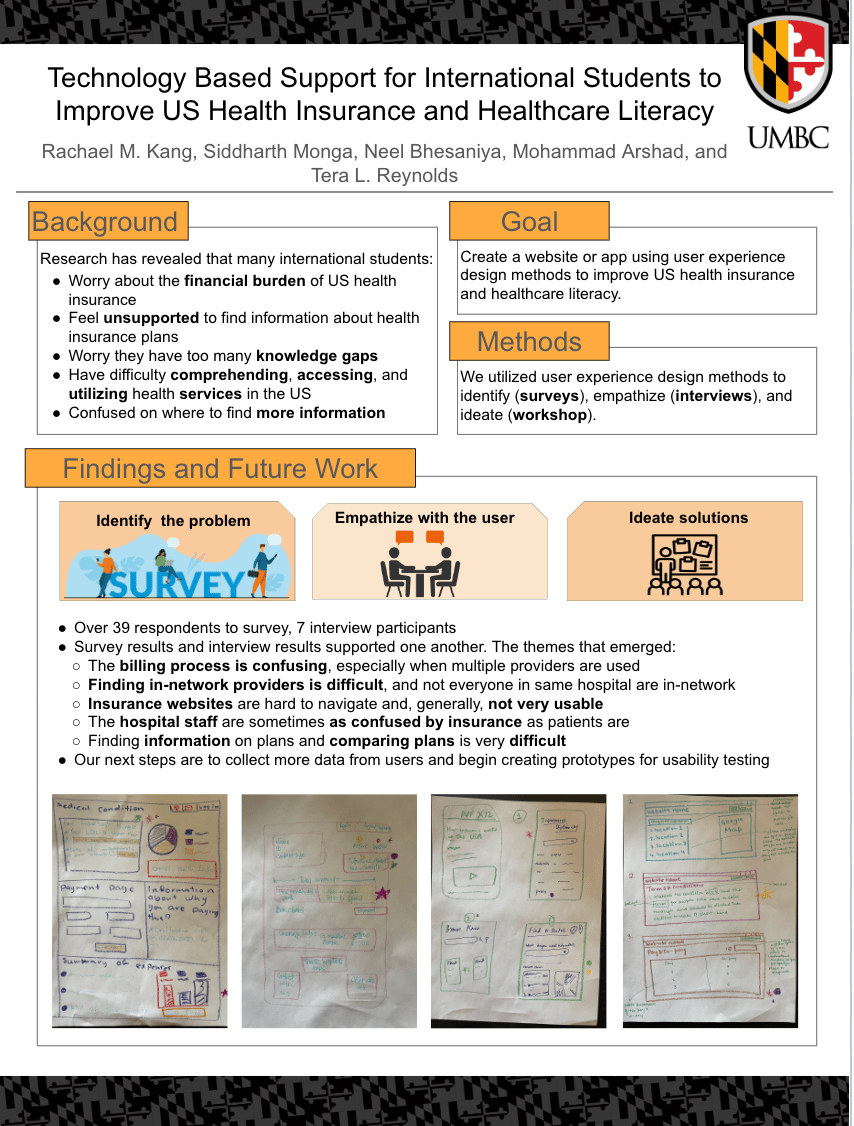
Our goal was to improve international students' healthcare literacy through a user-centered, participatory design approach that empowers them with the knowledge and tools needed to make informed health insurance decisions.
Problem:
Research shows that international students often experience confusion, frustration, and stress when trying to understand the U.S. health insurance system. Specific pain points include:
- Difficulty understanding insurance terms.
- Uncertainty about what is covered under their plans.
- Challenges finding in-network providers.
- Complicated billing processes with multiple providers.
Our goal was to improve international students' healthcare literacy through a user-centered, participatory design approach that empowers them with the knowledge and tools needed to make informed health insurance decisions.
Key Findings:
- Knowledge Gaps: Students had trouble understanding coverage, finding in-network providers, and navigating insurance websites(Poster Presentation.
- Modality Preferences: Survey participants indicated a preference for learning through digital tools, including websites, walk-through tutorials, and instructional videos.
- Frustration with Billing: The billing process, especially when involving multiple providers, was cited as a major source of confusion.
Design Process:
Using these insights, we moved forward with a participatory design process that directly involved international students in shaping the solution.
- Empathize: We conducted listening sessions to capture the frustrations and pain points of international students when dealing with health insurance. Students emphasized the need for more transparent and accessible information, particularly around billing and finding covered providers.
- Ideate: During our co-design workshops, students brainstormed and sketched solutions that would meet their specific needs. Ideas included a simplified insurance dashboard, walk-through tutorials, and a glossary of terms.
- Prototype: We created initial prototypes based on these ideas using Figma, including an app that offers step-by-step guidance through the insurance enrollment process, provider search, and billing management.
Testing and Iteration:
The prototypes were tested with users through two rounds of usability testing. Key feedback included:
- Positive Reception: Participants appreciated the intuitive navigation and clear step-by-step guidance for enrollment and finding providers.
- Room for Improvement: Suggestions included simplifying the navigation even further and providing more detailed explanations of insurance terms.
Outcome and Impact
- Increased Literacy: Surveys conducted after the usability testing showed a 40% increase in understanding of U.S. health insurance processes among international students.
- Scalability: The design solution was not only intended for UMBC students but has the potential to be scaled to support other international students and immigrant populations across the U.S.
Conclusion and Next Steps
This project highlighted the importance of user-centered design in creating impactful solutions for underrepresented populations. By engaging directly with international students, we were able to create a product that addressed their specific pain points and made the U.S. healthcare system more navigable. Our next steps involve refining the prototype further and conducting more extensive testing with a diverse set of users to ensure the solution is as inclusive and effective as possible.
Thanks for reading!
If this case study resonated with you, I’d love to connect and chat more. Feel free to reach out.
Siddharth Monga
Designing with empathy, clarity, and intent.
Work
Blog
Case studies
Customer stories
Best practices